Last night “No Other Land,” a documentary about Masafer Yatta, won an Oscar. While I appreciate how it captures Zionist settler and military terrorism, and send deepest congratulations to Basel and his family, I take issue with how the film was structured, as well as how Yuval, the Israeli co-director, talks about it to media.
Donate to sustain the work, here!
In their acceptance speech, Basel spoke for a much shorter time than Yuval. It surprised me that Yuval chose to speak at all, as the film was about Basel and life in Masafer Yatta. What could have been an opportunity to center Palestinian voices, when the whole world was listening, instead became a platform for Yuval to parrot liberal Zionist propaganda: he almost immediately condemns Hamas’s strategy of taking hostages on October 7, but fails to mention that Israel has abducted thousands and thousands of people. The state often labels them prisoners, but in reality they have committed no crime and have not received a fair trial. Even in the film we see how Basel’s dad was arrested for nothing, in order to emotionally torture the rest of his family, some of whom attended a demonstration protesting house demolitions a few days prior. The IOF frequently makes unfounded arrests to terrorize Palestinians. I have not met a single man in Masafer Yatta who has not spent time in jail. But unlike Hamas, who treat their hostages with dignity, Israel tortures theirs to death.
It is morally bankrupt to condemn armed resistance from a people who have been undergoing ethnic cleansing since 1948. As a citizen of the country actively committing genocide against Palestinians like Basel, Yuval’s comments are especially disgusting. Oppressed people all over the world have begged for liberation, but begging alone has never given a person her freedom or her life back. Invading countries are never moved by their victim’s tears to retreat.
When Yuval says “there is a different path, a political solution without ethnic supremacy and national rights for both our people,” I wonder what political solution he is referring to. It certainly does not seem like he believes in the dissolution of Israel, but rather a reformed version where Palestinians can be tried in regular court instead of military court, or maybe drive on the same roads. He gives the impression that if only Israel had better policies, things would be better. This is a lie. Settler colonialism is not just an issue of equal rights.
I have heard a few people in Masafer Yatta worry that the film normalizes colonization and focuses too much on the relationship between Basel and Yuval, as if friendship between the colonizer and the colonized can end oppression. I was told how last spring, when the movie premiered in their town, apartheid buses full of settlers entered the village and parked outside Basel’s house, blocking the narrow street from use, in order to watch. The film never condemns Israel or Zionism outright, so the settlers could still sleep easy that night, thinking they are some of the “good ones.”
“No Other Land” didn’t need Yuval in it at all, but perhaps his presence made Western audiences more comfortable and trusting of what they saw on the screen. Palestinians have been documenting their lives forever, but internationals are often quick to assume that Palestinians must have done something to deserve their treatment. I just hope that Yuval donates every shekel he makes to Masafer Yatta. The people whose trauma leads to his profit deserve that and more.
Here is a page from Mohammed el-Kurd’s book, “Perfect Victims,” where he talks about co-directed films:
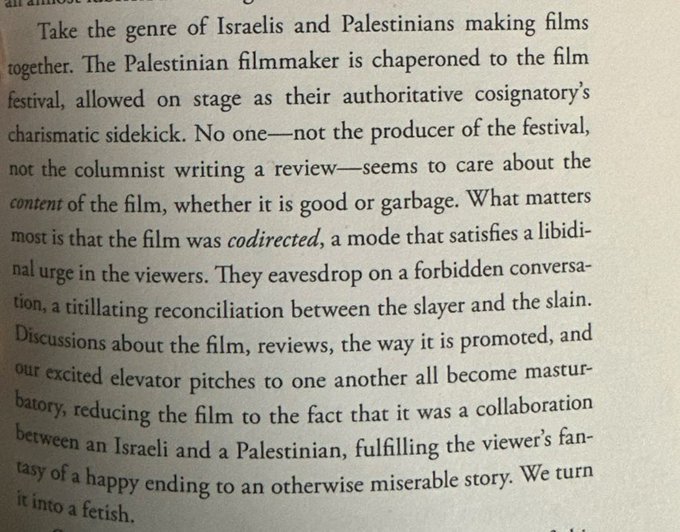
This is a pertinent reflection to keep in mind as this documentary continues to get media attention. Would it win as many awards if it didn’t involve Israelis?
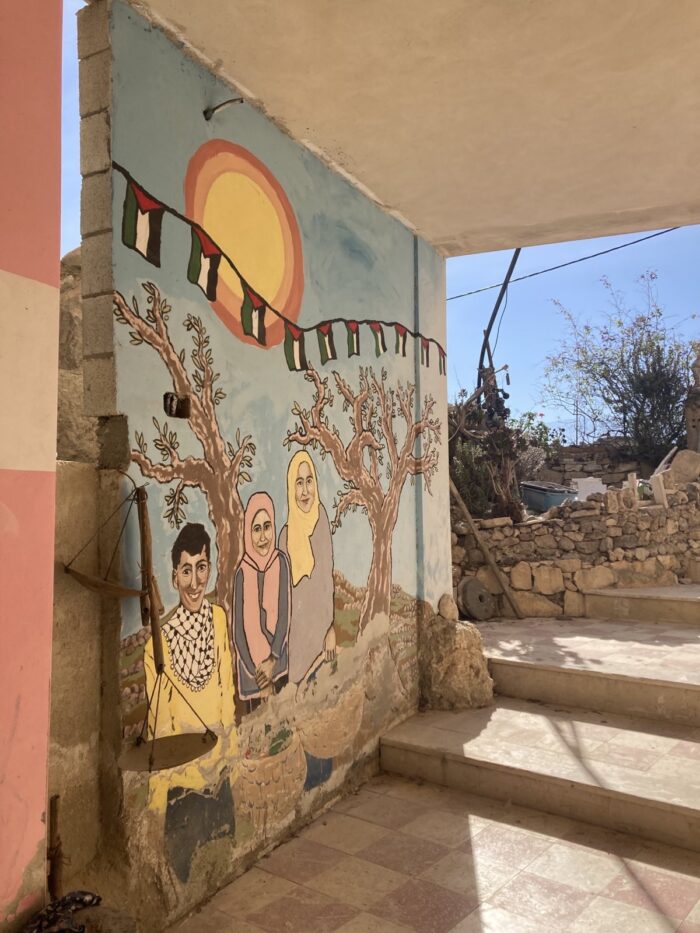
To watch this film in the United States, you can either see it in theaters or use a VPN, select an address from the UK, make an account with the public service broadcaster Channel 4, and view it for free. The image below is a beautiful mural on a wall below Basel’s house.